
Senticor · Pilot
openDesk: multicloud operations and recovery safeguards
A Senticor pilot for openDesk, an open-source office and collaboration suite. The work combines a rebuildable application runtime with retained data, independent mail reception and safeguards for upgrades and shutdowns.
Situation: software choice creates operating responsibilities
An open-source workplace is a collection of services with shared identity, storage and mail dependencies. Selecting the applications leaves a second decision: who owns their lifecycle and how do changes preserve existing data and communication?
- Microsoft 365 and Google Workspace combine office and communication products as cloud services.
- Nextcloud Hub combines files, collaborative editing and communication, with self-hosting available.
- openDesk integrates open-source workplace applications. Community can be independently operated; public administrations also have Enterprise support and operating-model options.
Senticor's pilot used planned application pauses. That made lifecycle coordination a concrete engineering problem: application capacity could be rebuilt, but stored documents, identities and email could not be treated as disposable infrastructure.
Task and my contribution
My work covered lifecycle automation, upgrade safeguards, mail integration and incident investigation. The operating model separated functions that could pause from those that needed to continue, and made destructive steps conditional on evidence that retained state was safe.
The scope included infrastructure configuration, deployment customisations, operating scripts, checks and runbooks. The accepted trade-off was limited application availability in a pilot, with data retention taking precedence over uninterrupted access.
Actions: control changes across service boundaries
Separate the runtime from durable state
openDesk applications and mailboxes run on Google Kubernetes Engine. Terraform describes the GCP infrastructure; Helmfile customisations and scripts manage installation and lifecycle. Retained application disks and independent snapshot scheduling survive runtime pauses. An Ansible-managed STACKIT host provides mail reception and start/stop control; that retained host is deliberately outside Terraform's lifecycle.
Treat an upgrade as a change to data contracts
The upgrade proceeded through an intermediate release. Comparing rendered deployments checked persistent-volume claims, stateful storage templates and mail service interfaces. A changed upstream default would have selected a different object store on a cold rebuild. Explicitly retaining MinIO kept the installation connected to its existing store instead of creating a new empty one.
Make mail continuity and shutdown separate decisions
An independent MX mail receiver accepts and queues incoming messages while the application runtime is paused. It provides continuity of acceptance, not mailbox access. Shutdown must first drain the application's SMTP queues, stop their writers and verify the actual queues are empty. A failed or inconclusive check blocks teardown: the controller cannot infer safe shutdown from a successful command alone.
Investigate user access across dependencies
A restart incident left a healthy webmail application behind the public readiness gate. Correcting selection and state transitions restored access. Another investigation tied portal and mail symptoms to shared identity-service saturation. These records informed checks of login and delivery across the complete path, alongside component health.
Results: implemented controls and observed behaviour
Implemented
The pilot has a documented lifecycle across two providers, staged upgrade safeguards, independently scheduled disk snapshots and a mail-drain gate before runtime teardown. A retained-disk cleanup near-miss also led to inventory checks that refuse uncertain deletion and regression coverage.
Verified in the operating records
The records show an applied upgrade, restored public access and login after the gate correction, a complete ready snapshot set, and successful mail-queue preparation, offline inspection and service resumption. These are distinct observations, rather than an inference that every recovery scenario works.
Operating boundary
This remains a pilot with accepted downtime. The single MX receiver has finite queue retention; it is neither redundant nor covered by the GCP disk snapshots. Those snapshots are per-disk copies, not proof of an application-consistent restore. A complete isolated restore remains unproven. GCP and Cloudflare dependencies remain; neither full sovereignty, savings nor an availability improvement is claimed.
Lessons for platform decisions
- Define lifecycle boundaries before automating deletion: Runtime, persistent state, mail queues and recovery inputs have different lifetimes. Automation needs an explicit inventory and conditions under which it must refuse to proceed.
- Validate contracts across upgrades: Successful deployment is insufficient when storage defaults or service interfaces change. Existing data must remain reachable after both in-place upgrades and cold rebuilds.
- Separate service objectives: Accepted, forwarded and readable email are different states. A single availability indicator hides those dependencies and their separate failure modes.
- Make recovery a demonstrated operation: Snapshot existence, restore prerequisites and successful application recovery are different evidence. Production adoption needs the missing restore exercise and explicit service objectives.
Project and background
This case draws on Senticor’s own pilot operations records. The linked products provide market context; no comparative product test was performed.
Architecture: runtime, data and shutdown conditions
The topology separates mail acceptance, applications and durable data. A distinct control flow shows which checks must pass before the runtime may be removed.

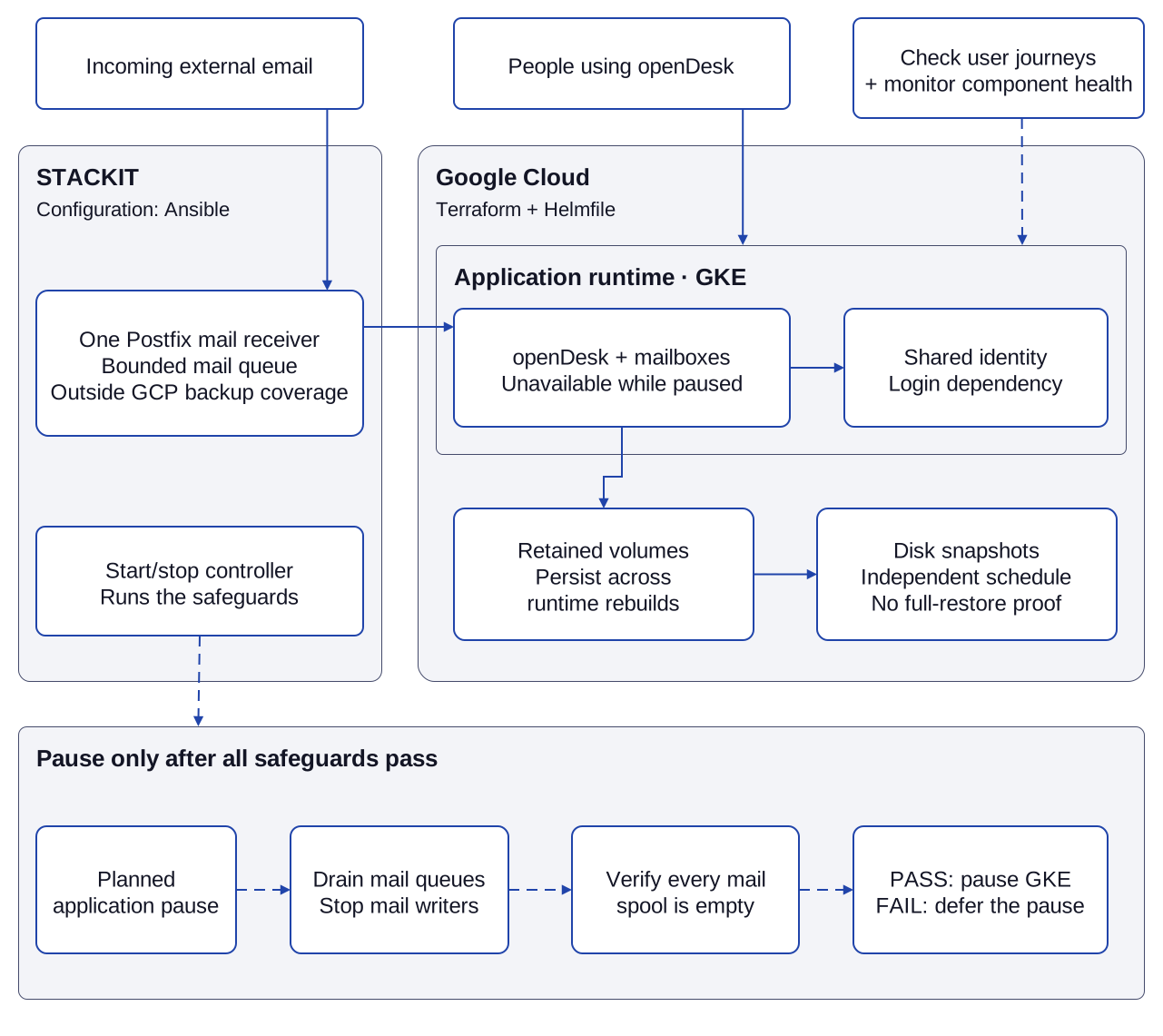
Text description of the diagram
- STACKIT operates separate mail reception and runtime control. Its queue can hold mail during application pauses while that single receiver remains available.
- Google Kubernetes Engine runs openDesk applications and mailboxes. Identity services are a shared dependency; persistent disks retain data beyond the application runtime.
- Infrastructure and deployment configuration make changes inspectable. The retained STACKIT host has a separate lifecycle. Independent snapshots protect disks without establishing a complete application-consistent recovery point.
- Before shutdown, application SMTP queues must be drained, SMTP writers stopped and the actual queues inspected offline.
- Only a confirmed safe state permits runtime removal. Failure or uncertainty prevents runtime removal. Reachability and login need checks alongside individual component health.
Services and projects
Contact
Send the project, requirements and timeframe by email.